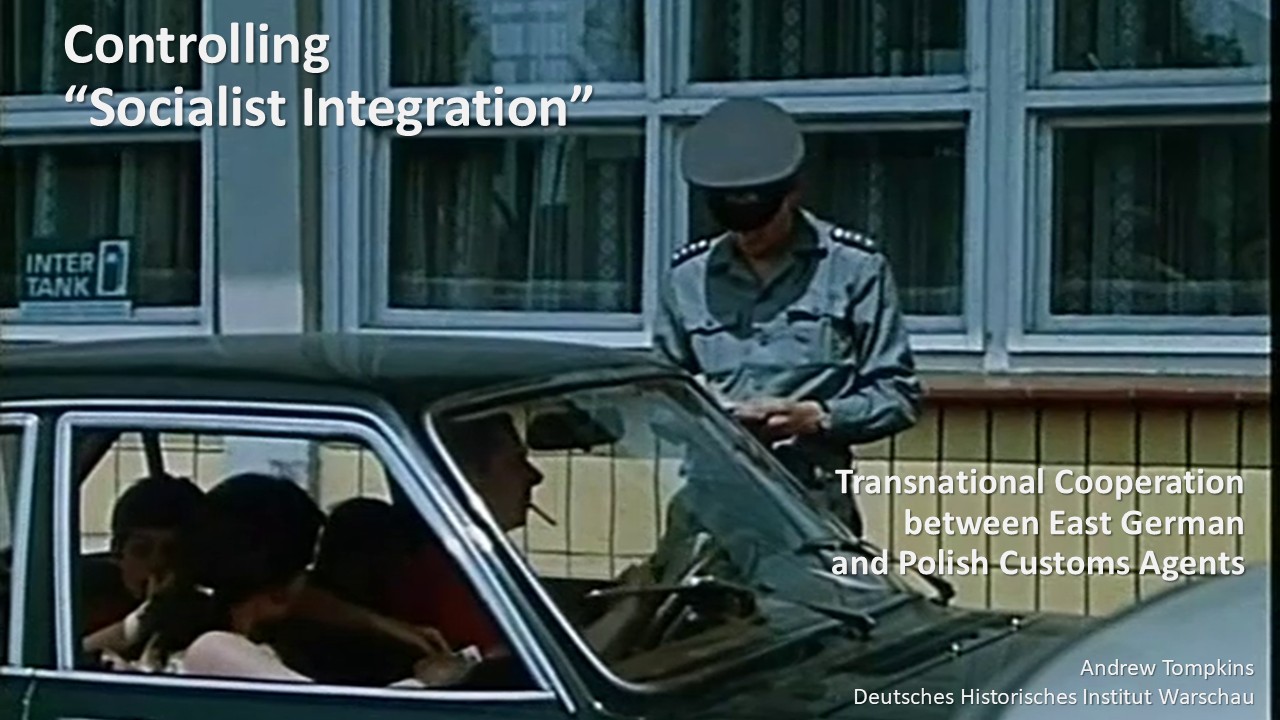
Presented at the 2025 Association for Slavic, East European, and Eurasian Studies conference in Washington, D.C. as part of the panel “Revisiting ‘Socialist Integration’: Transnational Cooperation and Its Challenges under State Socialism”
Introduction: On January 8th, 1989, East German customs officials at a jointly operated checkpoint on the Polish side of the border in Zgorzelec inspected the vehicle of a Polish traveler, Mariusz K. Having caught K. smuggling goods hidden in his car twice in the preceding two months, GDR officers pulled out all the stops this time. When they heard unusual noises after knocking on the top of the car, they instructed K. to unscrew the light fixture in the vehicle’s roof. He refused, claiming that he did not have to follow East German instructions while on Polish territory. As he walked away to get help from Polish customs officers, an altercation ensued. Within days, the Polish Press Agency published a report—later picked up by West German media—under the headline “East German customs officers hit Polish tourist.” By the end of the month, East German institutions in Poland were receiving bomb threats and phone calls comparing GDR customs officers to Nazis. One Polish man demanded a written statement from East German officials stating that his daughter would not be beaten up at the border.
Though cases of physical abuse such as this were seemingly rare, the resonance of Mariusz K.’s claims against GDR agents in the Polish press reflects the poor esteem in which many travelers held socialist customs agents, especially East German ones. This low public regard for customs agents stood in contrast to how they regarded their own transnational cooperation as a showcase of “socialist integration” from the 1970s onward. I want to look at customs officers today with regard to their role in transnational experiences under socialist integration. What was socialist integration to customs agents and how did it intersect with their work? How did East German and Polish agents cooperate with one another? And how did they shape travelers’ perceptions of socialist integration?